
Page Title
Diagnosing Apple Tree Fruit Problems
Text
You may see many different issues on the surface of your apples as they ripen on their branches. Below are some of the most common ones we're likely to experience here in North Dakota.
Sections
Conotrachelus nenuphar
Symptoms
- Plum curculio is a mottled brown weevil with a curved snout that causes both feeding and egg-laying damage in apples.
- Adult plum curculios usually appear at the time that apple trees bloom.
- Feeding damage appears as small, round holes.
- Adults puncture the apple skin to lay eggs and create tan, fan-shaped scars.
- Larvae cannot develop in the expanding apple flesh if the apple remains attached to the tree.
- Plum curculios can cause premature apple drop and will continue to develop and feed in the fallen apple that is beginning to rot.
- Plum curculios cause more damage in plums, apricots and tart cherries.
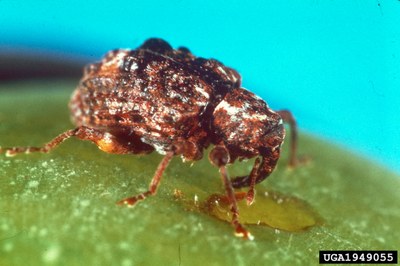
Adult plum curculio with curved snout. (E. Levine, The Ohio State University, Bugwood.org)
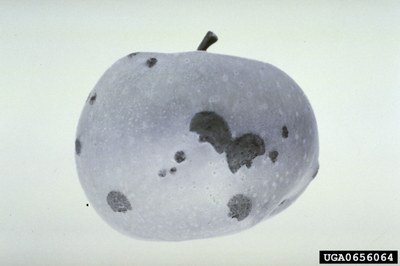
Damage from egg-laying causes fan-shaped scars (New York State Agricultural Experiment Station, Cornell University, Bugwood.org)
Management and other important facts
- At the time of blooming, monitor for adult plum curculios by shaking a branch and seeing what falls out of the tree onto a paper plate; monitoring is best done in the morning when the temperatures are cool and the insects are inactive.
- Insecticides containing the active ingredient malathion are effective; malathion is toxic to bees so do not apply until after petal fall; a second application may be made 7-10 days later.
- Do not apply insecticides containing carbaryl because this may cause fruit abortion if applied within 30 days after bloom.
- Practice good orchard sanitation by promptly disposing of fallen fruit.
Author: Esther McGinnis
Symptoms
- Signs of both diseases are more likely to occur in late summer.
- Sooty blotch appears as black or gray smudges on the apple’s surface; the smudges can be rubbed off in most cases.
- Flyspeck appears as a group of tiny, distinct black dots that cannot be rubbed off the fruit easily.
- Signs of both diseases may be present on the same apple.
- Both diseases are more prevalent in a year with cool temperatures and frequent rains in the spring and late summer/early fall.
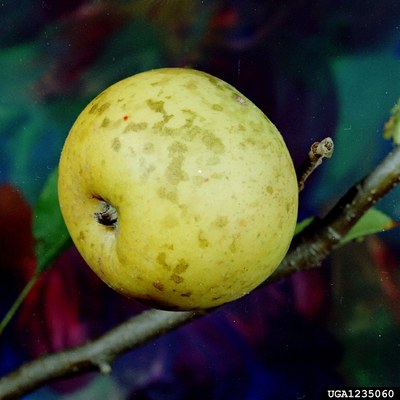
Sooty blotch. (Clemson University - U.S. Department of Agriculture Cooperative Extension Slide Series, Bugwood.org)
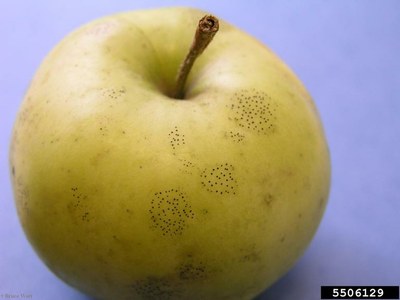
Flyspeck. (Bruce Watt, University of Maine, Bugwood.org)
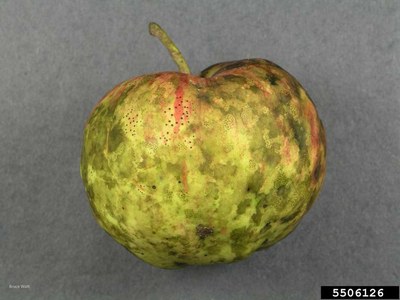
Apple with sooty blotch and flyspeck. (Bruce Watt, University of Maine, Bugwood.org)
Management and other important facts
- Both diseases cause superficial damage on the surface of the apple skin.
- The fungi can be removed by washing or peeling the fruit skin.
- The remainder of the apple can be used for cooking or eating.
- The fungi causing the diseases can be minimized by proper tree pruning to encourage good ventilation.
Author: Esther McGinnis
Symptoms
- Bitter pit causes dark lesions on the apple skin and just under the skin’s surface.
- The lesions appear primarily in storage but may sometimes occur just before harvest.
- The lesions may be bitter tasting.
- ‘Cortland’ and ‘Honeycrisp’ are highly susceptible to bitter pit.
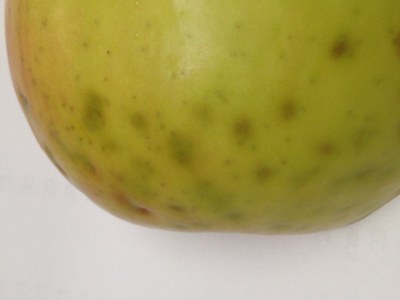
Bitter pit lesions initially look like light-green bruises on the surface of the fruit (Esther McGinnis, 线上赌博app)
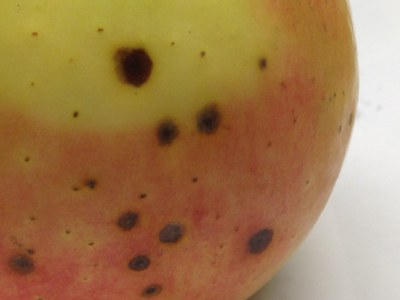
The lesions then become brown and slightly sunken (Esther McGinnis, 线上赌博app)
Management and other important facts
- Bitter pit is caused by the leaves out-competing the fruit for available calcium.
- Avoid over-fertilizing because high levels of nitrogen and potassium may exacerbate the problem.
- Maintain good soil moisture with supplemental irrigation during dry periods and apply mulch.
- Calcium chloride sprays can be applied directly to the fruit but are not always effective.
Author: Esther McGinnis
Cydia pomonella
Symptoms
- Codling moth larvae are the proverbial “worm in the apple”.
- The larvae tunnel through the apple to the core to eat the seeds.
- After they mature, the larvae tunnel out of the fruit to drop to the ground to spin a cocoon.
- Brown frass (insect poop) may line the tunnel.
- Adult male moths are grayish-brown with copper-colored tips.
- Larvae transition from white to pink and may reach ½” in length.
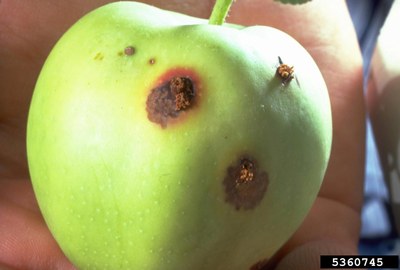
Tunnel entrances are often lined with insect frass (Eugene E. Nelson, Bugwood.org)
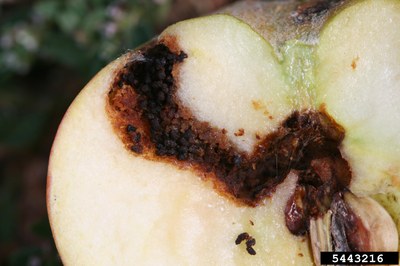
Insect tunnels are large and the damage renders the apple inedible (Whitney Cranshaw, Bugwood.org)
Management and other important facts
- Management may be unnecessary, because the moth may not be present in all areas.
- Pheromone traps may be hung in May to detect the presence of male moths.
- If male codling moths are detected, insecticides can be applied after flower petal fall.
- Insecticides that contain the active ingredients, malathion or pyrethrin, can be applied as long as the insecticides are labeled for apple trees.
- Do not use insecticides containing carbaryl because this may cause fruit abortion if applied within 30 days after bloom.
Author: Esther McGinnis
Symptoms
- Russeting produces brown, corky tissue on the apple skin.
- Sometimes it occurs in a netlike pattern.
- At its most severe, russeting may lead to skin cracking and moisture loss from the apple.
- ‘Haralson’ may be more susceptible to russeting.
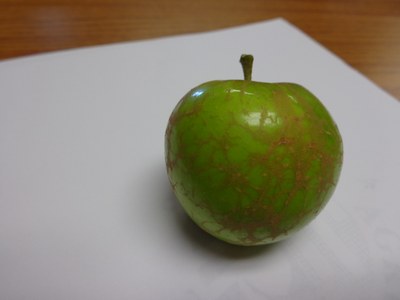
Netlike pattern on an apple (Esther McGinnis, 线上赌博app)
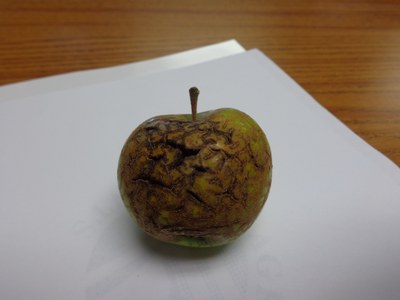
Severe russeting may lead to cracking (Esther McGinnis, 线上赌博app)
Management and other important facts
- Russeting may be caused by a number of different conditions including extended periods of high humidity, cool temperatures during early apple development, the application of copper-based and other caustic pesticides, and powdery mildew infections.
- Choose to plant apple cultivars that are less susceptible to russeting.
- Prune the tree to open the canopy and accelerate drying of the fruit.
- Be cautious in applying pesticides that are formulated as emulsifiable concentrates; wettable powder formulations are less likely to cause russeting.
- Avoid excessive application of nitrogen-based fertilizers.
Author: Esther McGinnis
This website was supported by the U.S. Department of Agriculture’s (USDA) Agricultural Marketing Service through grant 14-SCBGP-ND-0038.
Its contents are solely the responsibility of the authors and do not necessarily represent the official views of the USDA.
