Page Title
Diagnosing Apple Tree Leaves with Holes or Webbing
Text
Caterpillars and worms are often the reason your apple tree leaves may have holes and webbing start appearing. Learn the most common species to expect in our area and how to manage them.
Sections
Malacosoma americanum
Symptoms
- Eastern tent caterpillars feed on the leaves of apple, crabapple, chokecherry and cherry trees.
- Caterpillars hatch at the time leaves are breaking bud in the spring and will continue feeding for six to eight weeks.
- The larvae then spin cocoons and the adult moths appear in late June to early July.
- Feeding damage is conspicuous because caterpillars will consume entire leaves.
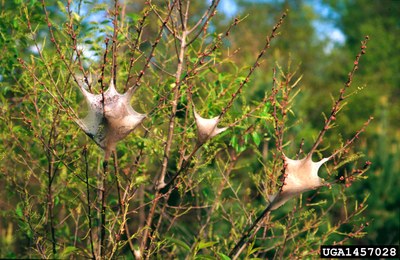
- At night and during cool, rainy weather, caterpillars will congregate in a webbed tent spun at branch junctions in trees.
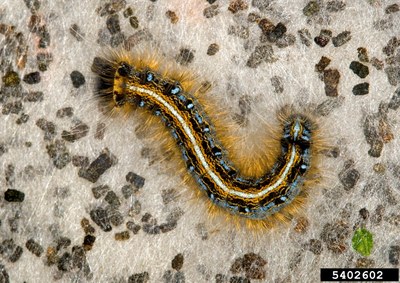
- These hairy caterpillars are blue and black and have a creamy-white stripe down the middle of their backs. The stripe is bordered by orange stripes on either side.
Caterpillars have prominent white and orange stripes. (David Cappaert, Bugwood.org)
Silken tents appear in the crotches of tree branches. (Steven Katovich, U.S. Department of Agriculture Forest Service, Bugwood.org)
Management and other important facts
- Mature trees can handle tent caterpillar defoliation better than younger trees.
- A simple organic control method is to use a stick to remove the webbing and caterpillars when they congregate in the silken tents during cool weather. Dispose of this mass to prevent further feeding and caterpillar maturation.
- If chemical control is to be used, pesticide applications should take place when larvae are outside the tent and feeding on leaves.
- If the tree is in flower, apply Bacillus thuringiensis (Bt) to the foliage near the tent. Bt is a biorational pesticide that will poison the caterpillars feeding on the treated leaves without hurting the bees or other pollinators.
- Other biorational pesticides include spinosad and insecticidal soap.
- If larvae are larger, conventional pesticides that include carbaryl or malathion may be more effective. Do not apply carbaryl within 30 days of petal fall to avoid apple drop.
Author: Esther McGinnis
Malacosoma disstria
Symptoms
- Forest tent caterpillar feed on the leaves of apple, crabapple and other fruit trees.
- Caterpillars hatch in early to mid-May and will continue feeding for five to six weeks.
- The larvae then spin cocoons and the adult moths appear in mid-July.
- Feeding damage is conspicuous because caterpillars will consume entire leaves.
- Despite their name, caterpillars do not spin silken tents.
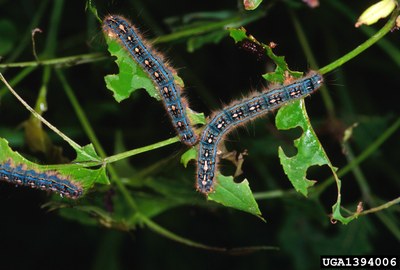
- These caterpillars are blue and black and have white keyhole spots down their backs.
Caterpillars have prominent white keyhole markings. (James B. Hanson, U.S. Department of Agriculture Forest Service, Bugwood.org)
Management and other important facts
- Mature trees can handle tent caterpillar defoliation better than younger trees.
- If the tree is in flower, apply Bacillus thuringiensis (Bt) to the foliage. Bt is a biorational pesticide that will poison the caterpillars feeding on the treated leaves without hurting the bees or other pollinators.
- Other biorational pesticides include spinosad and insecticidal soap.
- If larvae are larger, conventional pesticides that include carbaryl or malathion may be more effective. Do not apply carbaryl within 30 days of petal fall to avoid fruit abortion.
Author: Esther McGinnis
Hyphantria cunea
Symptoms
- Fall webworm caterpillars are active from late July into September.
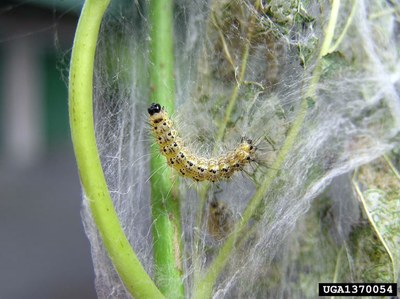
- The hairy caterpillars are yellow to green and have two rows of black spots on their backs.
- Fall webworm skeletonize leaves that are enclosed within a webbed shelter.
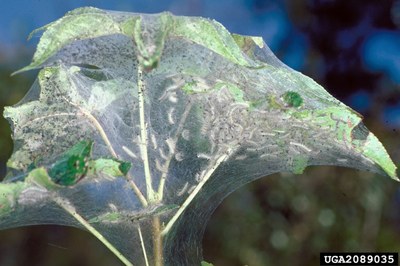
- Their webs differ from those of tent caterpillars in that the webbing covers branch ends rather than tree crotches.
Fall webworm caterpillars with distinctive black spots. (Milan Zubrik, Forest Research Institute-Slovakia, Bugwood.org)
Webbing covers branch ends. (Lacy L. Hyche, Auburn University, Bugwood.org)
Management and other important facts
- Mature trees can handle fall webworm infestations and control measures usually are not required; this is more of an aesthetic issue.
- Fall webworm infestations in younger trees should be removed to prevent severe defoliation.
- Webbing and caterpillars can be removed with a stick and dropped into a pail of soapy water.
- Chemical control usually is not effective because the webbing protects the caterpillars.
Author: Esther McGinnis
This website was supported by the U.S. Department of Agriculture’s (USDA) Agricultural Marketing Service through grant 14-SCBGP-ND-0038.
Its contents are solely the responsibility of the authors and do not necessarily represent the official views of the USDA.