Title

2025 Extension Soybean Pathology Field Research Reports

(PP2290, January 2026)
Other Authors

Authors:
Wade Webster, Gabe Dusek and Hope Becton

Editors:
Samuel Markell, Andrew Friskop and Eric Branch

Collaborators:
Fargo – Main campus
Ana Carcedo, Carrie Dottey, Joe Ikley, Janet Knodel, Gustavo Kreutz, Lindsay Malone, Tonny Obua, Guiping Yan, Pat Beauzay, Joel Bell, Chad Deplazes, Bryan Hansen, Ben Harms, Mike McKenna, Addison Plaisance, Jess Scherer, Austin Weippert, Cole Williams, Daryl Ritchison and the NDAWN Team
Carrington Research Extension Center
Michael Wunsch
Dickinson Research Extension Center
Victor Gomes
North Central Research Extension Center
Chandler Gruener, Leandro Bortolon,
Oakes Irrigation Research Site
Heidi Eslinger, Spencer Eslinger, Thomas Miorini
Williston Research Extension Center
Edson Ncube

Availability
Availability:
Web only
Publication Sections

North Dakota Soybean Disease Summary - 2025

Brown Stem Rot

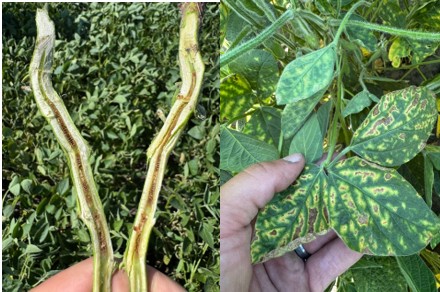
Brown stem rot, caused by the fungus Cadophora gregata, is a vascular disease of soybean that primarily infects and colonizes the stem pith. This disease can reduce plant vigor, cause premature leaf death and lead to notable yield losses, especially when infections align with environmental stress such as cool, wet conditions early in the season. The pathogen survives in soybean residue, infects roots early in the growing season and progresses systemically up the plant, with symptoms typically becoming evident during mid- to late-reproductive growth stages. During 2025, brown stem rot was observed across eastern North Dakota in early August, but did not develop to severe levels, resulting in minimal yield impacts.
Brown Stem Rot
Brown stem rot sample identified in Cass County in early August.

Frogeye Leaf Spot

Frogeye leaf spot, caused by the fungus Cercospora sojina, is a foliar disease of soybean that produces characteristic circular lesions with dark borders and light centers. This disease can significantly reduce the total photosynthetic area, weaken plants and lead to measurable yield losses, particularly in susceptible varieties under warm, humid conditions. The pathogen overwinters in infected residue, produces spores during periods of leaf wetness and spreads via wind and rain splash, leading to repeated cycles of infection throughout the growing season. Frogeye leaf spot has been increasing in prevalence and severity since its first identification in North Dakota in 2020. In 2025, frogeye leaf spot was identified in 28 counties in North Dakota through our field scouting. However, yield impacts were minimal.
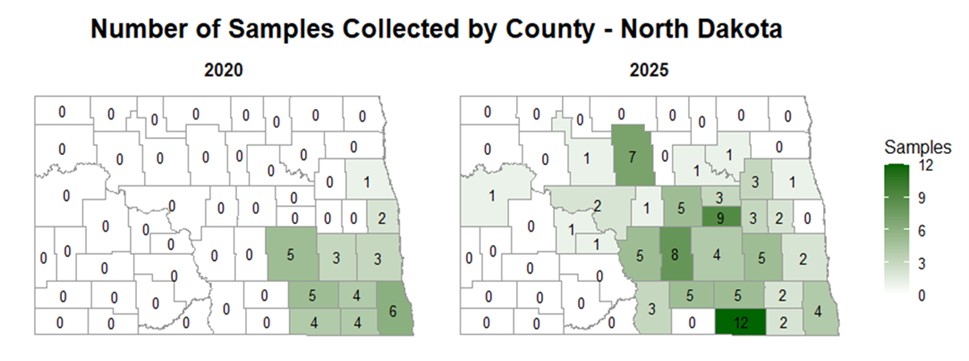
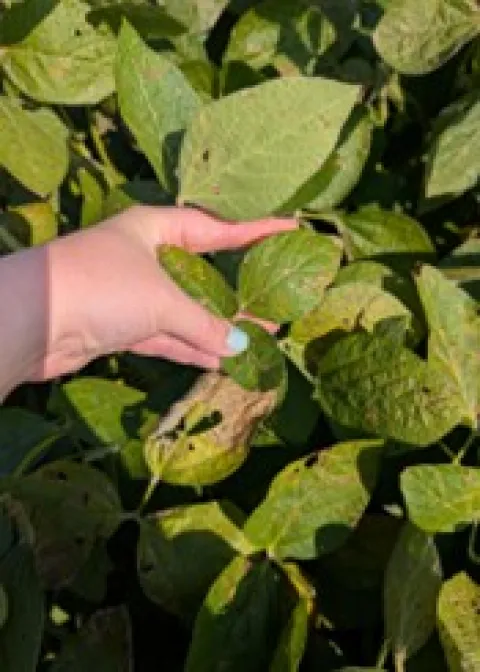
Figure 1
Symptomatic frogeye leaf spot samples collected by North Dakota county during the 2020 and 2025 growing seasons, respectively.
Soybean leaves
Soybean leaves symptomatic of frogeye leaf spot were observed in a farmer’s field in Kidder County, North Dakota, on Sept. 10, 2025, with an approximate 50% field incidence and up to 10% severity.

Phytophthora Root and Stem Rot

Phytophthora root and stem rot, caused primarily by Phytophthora sojae, is a destructive soilborne disease of soybean that attacks roots and lower stems. Recently, there has been a second Phytophthora species identified, which is capable of infecting soybean, called P. sansomeana, but the impact of this pathogen is still unknown in North Dakota. This disease can cause damping-off, stand loss, reduced plant vigor and significant yield reductions, especially in poorly drained or saturated soils where infection pressure is high. The pathogen survives in the soil as long-lived oospores, infects roots shortly after planting under wet conditions and continues to reinfect throughout the season as new zoospores are produced. Despite consistent moisture across much of North Dakota in 2025, Phytophthora root and stem rot did not develop at high levels.

Red Crown Rot

Red crown rot, caused by the fungus Calonectria ilicicola, is a soilborne disease of soybean characterized by red discoloration at the stem base and root decay. This disease can reduce stand establishment, stunt plant growth and cause significant yield loss, particularly in warm, wet environments where the pathogen thrives. The pathogen survives in soil and residue, infects roots early in the season and progressively colonizes the lower stem, with symptoms intensifying as plants reach reproductive stages. Traditionally, a disease of southern production systems, red crown rot has been moving northward for the past few years. After extensive field scouting in 2025, no red crown rot has been identified in North Dakota. However, there has been a confirmed report in southwest Minnesota in late fall 2025.

Seedling Diseases

Seedling diseases of soybeans occur as a complex caused by multiple soilborne pathogens, including Pythium, Phytophthora, Rhizoctonia and Fusarium, that attack seeds and young seedlings during the earliest growth stages. Collectively, these diseases reduce stand establishment, slow early-season soybean growth and can permanently limit yield potential long before plants reach full canopy. The pathogens survive in the soil for many years, infect under stress-prone conditions such as cool, wet soils or compaction, and often co-occur, making it difficult to diagnose individual species without laboratory confirmation.

Pythium damping-off, caused by multiple Pythium species, is an oomycete (water mold) disease that attacks soybean seeds and seedlings, particularly under cool, wet soil conditions. This disease can lead to poor stand establishment, pre- and post-emergence damping-off and weakened seedlings that are slow to grow and vulnerable to additional stresses. The pathogen survives in soil as oospores and infects young roots shortly after planting, often spreading rapidly when soil remains saturated.

Rhizoctonia seedling blight and root rot, caused by Rhizoctonia solani, results in reddish-brown lesions on hypocotyls and roots that can girdle and kill young seedlings. This disease reduces plant vigor, delays canopy development and can lead to notable stand thinning in warm, moderately moist soils that favor pathogen activity. The fungus survives in soil and residue as overwintering structures (sclerotia) and infects seedlings soon after emergence, particularly when plants are stressed or growing slowly.

Fusarium root rot, caused by a complex of Fusarium species (F. oxysporum, F. solani, F. graminearum), affects soybean seedlings by attacking roots and lower stems early in the season. These pathogens can cause subtle reductions in vigor, discoloration of roots and chronic stand loss, ultimately reducing yield potential before plants reach the V2 stage. Fusarium spp. persist in soil and residue and infect seedlings under a wide range of conditions, often becoming more severe when plants are stressed by cold soils or compaction.

Collectively in 2025, seedling disease resulted in substantial yield impacts due to consistent moisture and plant stress early in the growing season. This led to reduced stands and poor root development which limited yield potential later in the season.

Soybean Cyst Nematode

Soybean cyst nematode (SCN), caused by Heterodera glycines, is the most economically damaging soybean disease in North America and parasitizes soybean roots by forming specialized feeding sites. This pest reduces yield by impairing root growth, limiting nutrient and water uptake and causing hidden yield loss even in the absence of obvious above-ground symptoms. The nematode survives in soil as long-lived cysts, hatches in response to soybean root exudates and completes multiple reproductive cycles per season, allowing populations to build rapidly under favorable conditions.

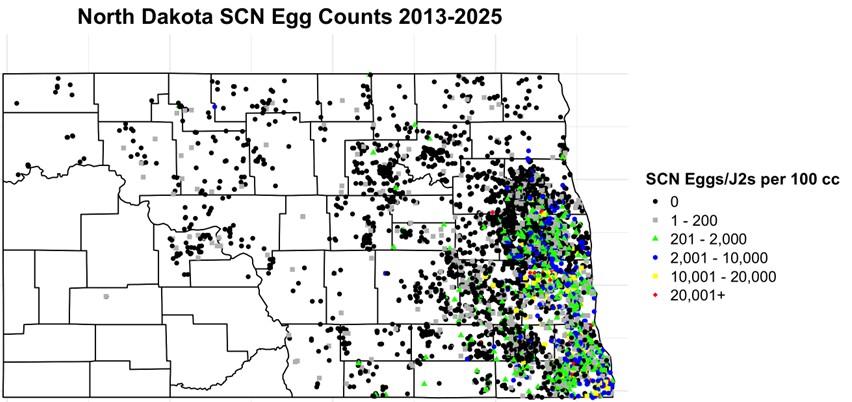
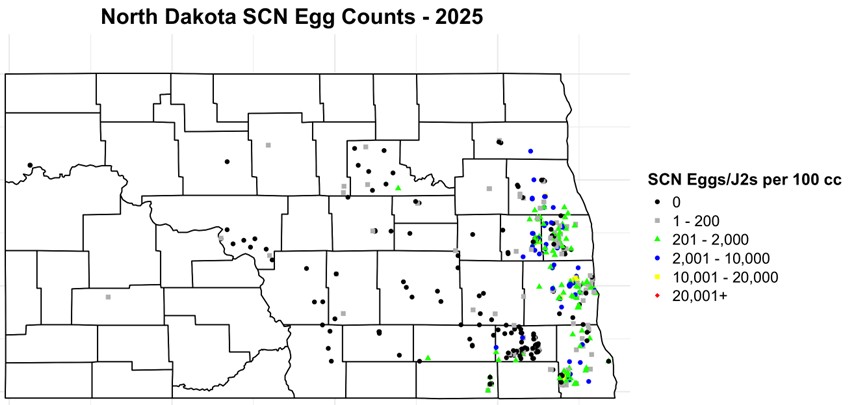
In the 2025 Soybean Cyst Nematode Sampling Program, a total of 466 soil samples were received and processed. From these samples, 40% were found to have no SCN present, 20% of samples had 1-200 SCN eggs + J2/100cc, 23% had 201-2,000 SCN eggs + J2/100cc, 15% had 2,001-10,000 SCN eggs + J2/100cc, 2% had 10,001-20,000 SCN eggs + J2/100cc and only one sample had greater than 20,000 SCN eggs + J2/100cc. The 2025 SCN figures are provided below.

Table 1
Figure 1
Evaluation of the number of submitted soil samples within each of the six classification levels. Figure 1A represents all samples, and Figure 1B represents all positive samples. Samples are classified based on their egg counts as either No SCN (0 eggs + J2/100 cc), Very Low (1-200 eggs + J2/100 cc), Low (201 – 2,000 eggs + J2/100 cc), Moderate (2,001 – 10,000 eggs + J2/100 cc), High (10,001 – 20,000 eggs + J2/100 cc) or Very High (greater than 20,000 eggs + J2/100 cc).
Figure 2
Map of North Dakota displaying SCN soil samples collected from 2013-2025. Samples are classified based on their egg counts as either No SCN (0 eggs + J2/100 cc of soil), Very Low (1-200 eggs + J2/100 cc), Low (201 – 2,000 eggs + J2/100 cc), Moderate (2,001 – 10,000 eggs + J2/100 cc), High (10,001 – 20,000 eggs + J2/100 cc) or Very High (greater than 20,000 eggs + J2/100 cc).
Figure 3
Map of North Dakota displaying SCN soil samples collected during 2025. Samples are classified based on their egg counts as either No SCN (0 eggs + J2/100 cc of soil), Very Low (1-200 eggs + J2/100 cc), Low (201 – 2,000 eggs + J2/100 cc), Moderate (2,001 – 10,000 eggs + J2/100 cc), High (10,001 – 20,000 eggs + J2/100 cc) or Very High (greater than 20,000 eggs + J2/100 cc).

Sudden Death Syndrome

Sudden death syndrome (SDS), caused by the soilborne fungus Fusarium virguliforme, is a root disease of soybean that leads to toxin-induced foliar symptoms. This disease can substantially reduce yield by impairing root function, limiting nutrient and water uptake and causing premature defoliation, with the greatest losses occurring in high-yield environments and susceptible varieties. The pathogen survives in the soil and in crop residue, infects roots shortly after planting under cool, wet conditions and produces toxins that move upward into the leaves later in the season, causing the characteristic interveinal chlorosis and necrosis. In 2025, SDS was identified in Richland, Cass and Dickey counties; however, disease severity was lower than expected, and yield losses are estimated to have been minimal and isolated to the southeast corner of North Dakota.

White Mold

White mold, caused by the fungus Sclerotinia sclerotiorum, is a stem disease of soybean characterized by white, cottony mycelium and the formation of black sclerotia on or within infected tissues. This disease can lead to severe yield losses by killing branches or entire plants, reducing pod set and limiting canopy development, especially in cool, wet and dense canopies that favor infection. The pathogen overwinters as sclerotia in soil, which germinate to produce apothecia that release ascospores, and infections occur when these spores land on senescing flowers during periods of extended moisture.
White Mold
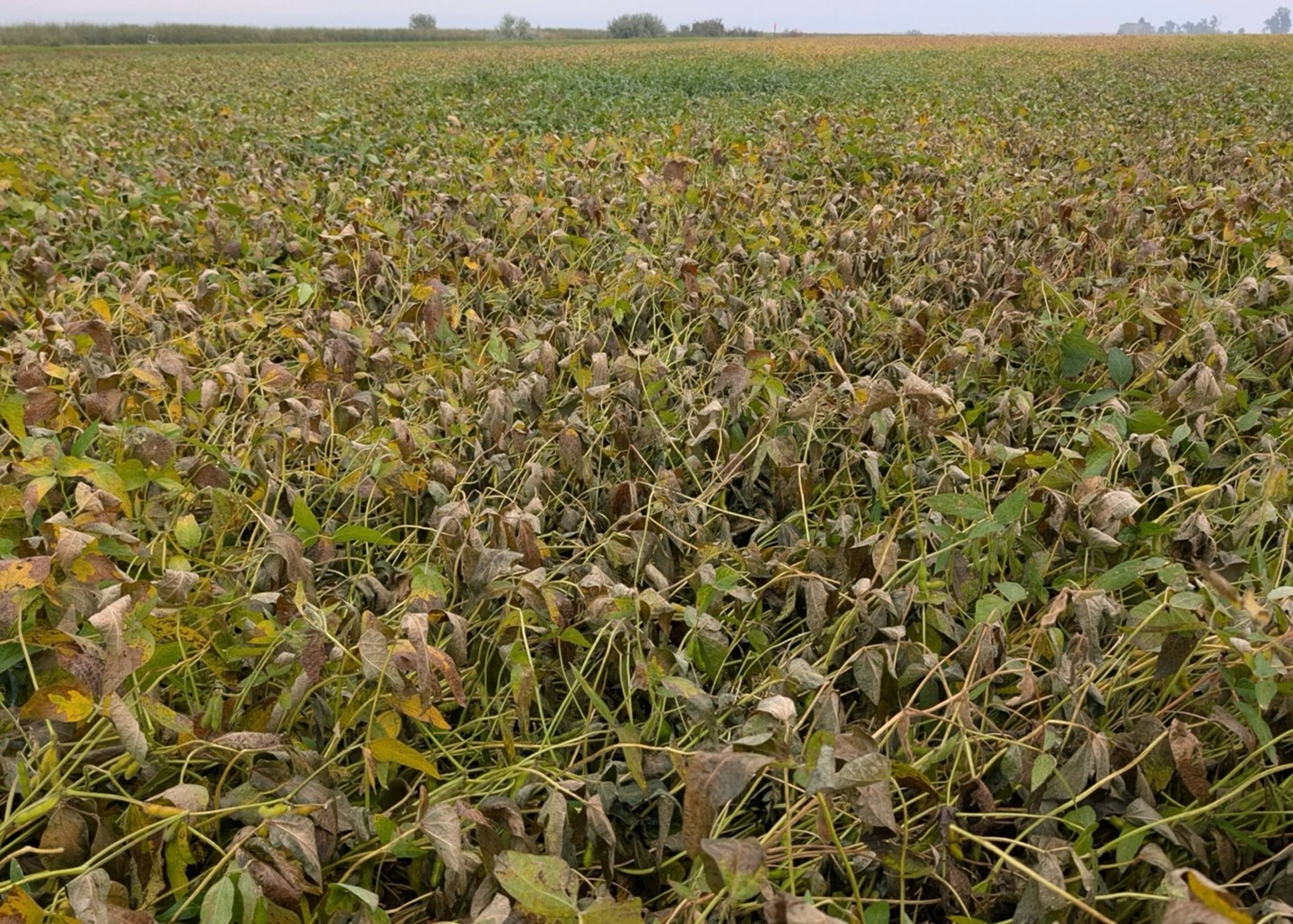
Field with high white mold pressure near Granville, North Dakota (McHenry County). Photo was taken Sept. 11, 2025.

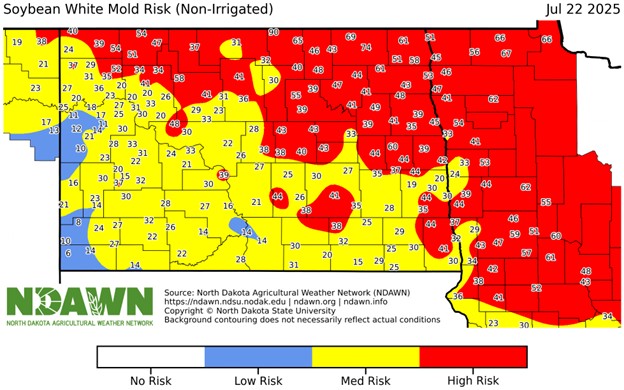
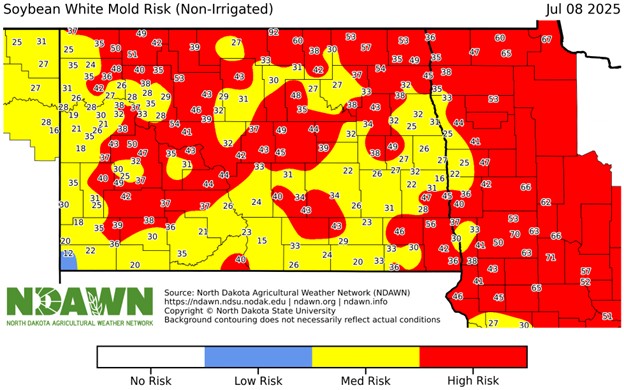
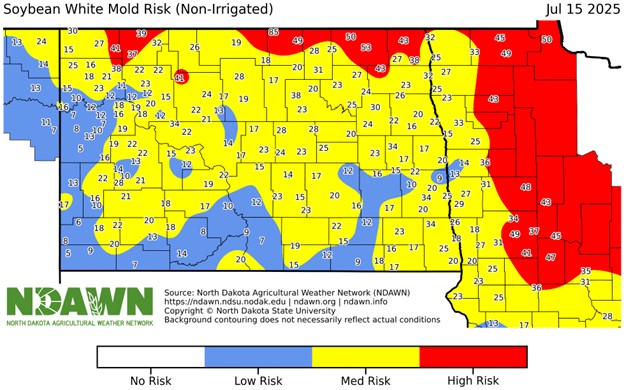
In 2025, environmental conditions were highly conducive to disease development, with high humidity, consistent precipitation and moderate temperatures less than 75 degrees Fahrenheit during the flowering growth stages (R1-R3). These conditions are outlined by the new NDAWN Soybean White Mold Risk Maps from three dates during flowering. As a result, white mold severity was high, and yield losses across North Dakota are estimated to be higher than in previous years. In addition to yield losses, severe white mold years are also known to increase the amount of new inoculum in the soil for future years, increasing the risk of disease development in future years.
White Mold NDAWN
Soybean White Mold Risk (Non-irrigated). White mold risk on July 8, 2025.
White Mold NDAWN
Soybean White Mold Risk (Non-irrigated). White mold risk on July 15, 2025.
White Mold NDAWN
Soybean White Mold Risk (Non-irrigated). White mold risk on July 22, 2025.

Each number on the map represents a single weather station from which weather data is pulled. These numbers represent the risk probability (%) of the apothecia (white mold mushrooms) forming on the soil surface. High risk is defined as “Red” and is when a fungicide application is recommended if canopy closure has occurred and flowers are present. Medium risk is defined as “Yellow” and indicates when to be cautious of environmental conditions and potentially prepare to make a fungicide application. If you are growing highly susceptible soybeans in a field with a long history of white mold, fungicide applications may be warranted in the medium risk “Yellow.” Low risk is defined as “Blue,” and fungicide applications are not recommended. NDAWN Soybean White Mold Risk Maps are available here. Be sure to stop back next season to evaluate white mold risk.

Experimental Designs

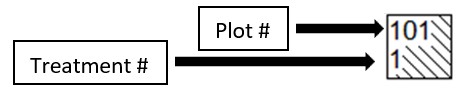
All experiment treatments are represented multiple times within reps for each experiment. A rep indicates how many times each treatment appears in an experiment (e.g., if an experiment has four reps, each treatment will appear four times in the experiment). Where the treatments are planted is often randomized within experiments to limit the amount of variation among treatments within the same rep. The type of variation that we attempt to reduce within each experiment includes, but is not limited to, environmental variation, soil variation, etc. To randomize where treatments are planted, we utilize a software called Agriculture Research Manager (ARM), which is one of the most commonly used programs when conducting crop protection research. Plots can vary in size from experiment to experiment, but a common size used in soybean disease research is 10 feet wide by 20 feet long. Treatments are given numbers within experiments to help with randomization and efficiency. An example is provided below.
Treatment Plot

This image represents a single plot from ARM, including the plot number and treatment number. Plot numbers often start with 101, but this can vary depending on the research program. Treatment numbers often start with 1.

Randomized Complete Block Design

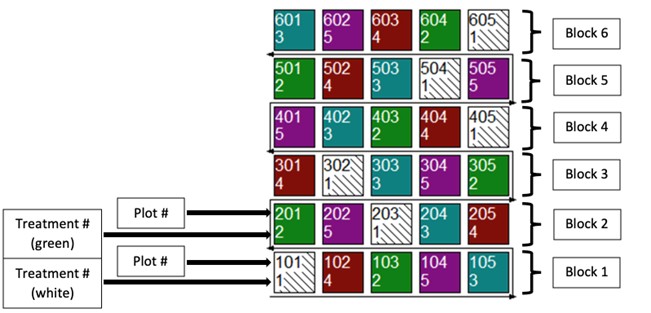
A randomized complete block design (RCBD) is an experimental design that randomizes experiment treatments within reps and divides reps using blocks. Treatment location is randomized within each rep, and the experiment is planted with the intent to minimize variation (e.g., environmental, soil) within a rep and maximize variation across reps. It is important to minimize variation within reps to ensure a fair comparison of treatments within that rep. To put this in a different perspective, if you were to plant half of a rep in a wet portion of the field and the other half of a rep in a dry portion, the environment would have a large amount of variation within that rep. Due to the large variation that would be present in this example, the way individual treatments perform could be heavily influenced by the environment and, therefore, make it appear as if some treatments work better than others when in reality that may not be the case. In the example below, there is an experiment that has five treatments and six reps. Each treatment is represented six times, once within each rep.
ARM

This is a full image output from ARM, indicating the entire experiment randomization in a randomized complete block design. Treatments are randomized within blocks and indicated by numbers and colors. This experiment has six reps of each treatment and therefore six blocks. Plots are numbered starting with 101 and increase by 100 for each block.

Research Reports

线上赌博app Extension does not endorse commercial products or companies, even though reference may be made to tradenames, trademarks or service names.

For more information on this and other topics, see www.ndsu.edu/extension

County commissions, North Dakota State University and U.S. Department of Agriculture cooperating. 线上赌博app does not discriminate in its programs and activities on the basis of age, color, gender expression/identity, genetic information, marital status, national origin, participation in lawful off-campus activity, physical or mental disability, pregnancy, public assistance status, race, religion, sex, sexual orientation, spousal relationship to current employee, or veteran status, as applicable. Direct inquiries to Vice Provost, Title IX/ADA Coordinator, Old Main 100, 701-231-7708, ndsu.eoaa@ndsu.edu. This publication will be made available in alternative formats for people with disabilities upon request, 701-231-7881.